
The Eternal Drape: A Comprehensive Study of the Maheshwari Handloom
Introduction: More Than a Fabric
In the landscape of Indian textiles, few weaves possess the quiet dignity of the Maheshwari saree. While the vibrant silks of Kanchipuram and the heavy brocades of Banaras speak of opulence, the Maheshwari speaks of grace, intellect, and resilience. Originating from the sacred town of Maheshwar on the banks of the Narmada River, this handloom is a testament to the vision of one of India’s greatest female rulers, Maharani Ahilyabai Holkar.
To understand the Maheshwari is to understand the soul of Central India—a blend of monastic simplicity and royal aesthetic.
Part I: The Historical Genesis
The 18th Century Renaissance
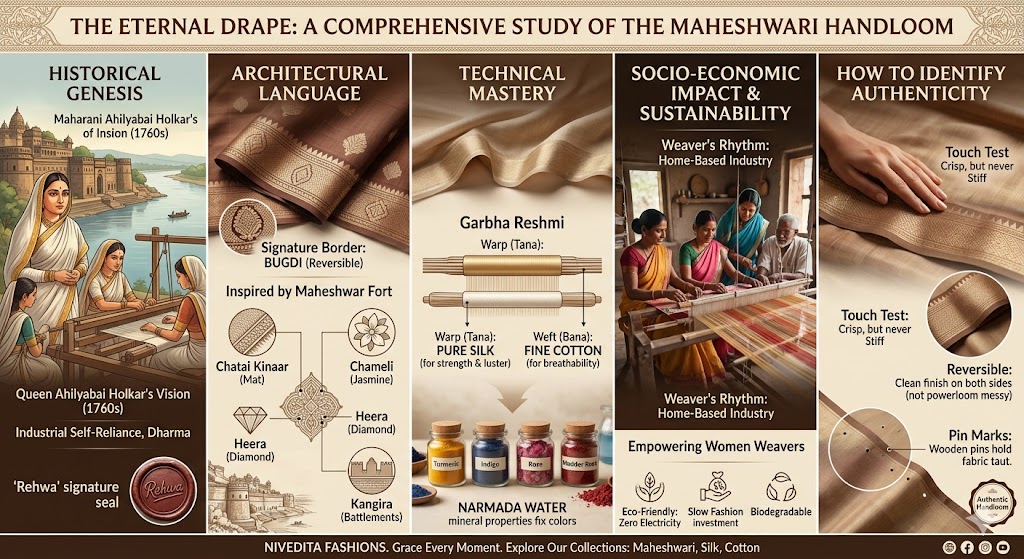
The story begins in the 1760s. Following the death of her husband and father-in-law, Ahilyabai Holkar took the reins of the Malwa kingdom. Unlike other rulers of her time who focused on territorial expansion, Ahilyabai focused on Dharma and industrial self-reliance.
She realized that for her capital, Maheshwar, to thrive, it needed a signature industry. She personally invited master weavers from the royal workshops of Surat, Mandu, and Varanasi. Her brief was specific: Create a saree that is lightweight enough for the hot Malwa summers, dignified enough for royal guests, and sturdy enough to last for generations.
Royal Patronage and Evolution
Initially, these sarees were woven in pure silk and used exclusively by the royal family and as gifts for visiting dignitaries. Over time, to make the fabric more breathable and accessible to a wider range of women, weavers began blending cotton into the weft while keeping silk in the warp. This innovation led to the birth of the “Garbha Reshmi”—a fabric that felt like a second skin.
Part II: The Architectural Language of the Weave
The most distinctive feature of a Maheshwari saree is its border. If you stand in the center of the Maheshwar Fort and look at the stone carvings, you are looking at a blueprint of the saree’s design.
1. The Motifs (Butis and Borders)
The weavers didn’t look for inspiration in far-off lands; they looked at their immediate surroundings.
- Chatai Kinaar: Inspired by the mats woven in the region. It represents the rhythmic interlacing of life.
- Chameli (Jasmine): A tribute to the local flora, symbolizing purity and fragrance.
- Heera (Diamond): A geometric representation of the gems found in the royal treasury.
- The Kangira: A jagged, tooth-like pattern that mimics the defensive battlements of the fort walls. It represents protection and strength.
2. The Reversible Border (Bugdi)
Technically known as the Bugdi, this is a hallmark of authentic Maheshwari craftsmanship. The border is woven in such a way that the pattern is identical on both the front and the back. This was a functional innovation—it allowed the wearer to drape the saree quickly without worrying about the “ulta” (reverse) side showing, a nod to the busy lives of the women in the Holkar court.
Part III: The Technical Mastery of the Loom
1. The Raw Materials
A Maheshwari saree’s quality depends on the “count” of the thread.
- Warp (Tana): Usually 20/22 denier mulberry silk. This provides the vertical strength and the subtle shimmer.
- Weft (Bana): 80s or 100s count fine combed cotton. This provides the horizontal volume and the “breathability.”
- Zari: Traditionally, real silver and gold wires were used. Today, high-quality tested zari (silk thread wrapped in metallic wire) is used to maintain the shine without the prohibitive cost.
2. The Dyeing Process
Maheshwar has a long tradition of using vegetable dyes. The water of the Narmada River is said to have specific mineral properties that help in “fixing” the colors, giving them a depth that is hard to replicate elsewhere.
- Aamra (Yellow): Derived from turmeric and marigold.
- Angoori (Green): A delicate mix of indigo and yellow.
- Gulabi (Pink): Extracted from rose petals and madder root.
Part IV: Socio-Economic Impact and Sustainability
The Maheshwari handloom industry is one of the few examples of a traditional craft that has survived the industrial revolution without losing its soul.
The Weaver’s Rhythm
In Maheshwar, the loom is often placed in the center of the home. It is a family affair where the men usually handle the heavy lifting of setting up the warp, and women handle the intricate weft and motif work. This domestic industry empowers women, allowing them to earn a livelihood while remaining the pillars of their households.
Environmental Consciousness
By its very nature, handloom is sustainable. It requires zero electricity. The carbon footprint of a handloom saree is negligible compared to power-loom fabrics. Furthermore, the use of natural fibers (silk and cotton) means the garment is biodegradable. In an era of “Fast Fashion,” the Maheshwari stands as a beacon of “Slow Fashion”—an investment that grows in value as it ages.
Part V: How to Identify an Authentic Maheshwari
As the popularity of these sarees has grown, so have the imitations. For a true connoisseur, these are the markers of authenticity:
- The Touch Test: A real Maheshwari will feel slightly “crisp” but never “stiff.” It should have a natural fall that drapes easily around the body.
- The Border Check: Examine the border. If the design on the back is a messy tangle of threads, it is likely a power-loom copy. An authentic handloom will have a clean, reversible finish.
- The “Pin” Marks: If you look at the selvage (the edge of the saree), you might see tiny pinholes. These are made by the wooden pins used to hold the fabric taut on the handloom.
Conclusion: The Grace of the Narmada
The Maheshwari saree is not just a garment; it is a philosophy. It teaches us that beauty does not need to be loud to be noticed. It reminds us that tradition is not about looking backward, but about carrying the best of the past into the future.
Whether you are walking into a boardroom or standing at a wedding altar, the Maheshwari provides a sense of groundedness. It is the legacy of Queen Ahilyabai, the sweat of the Malwa weavers, and the shimmering reflection of the Narmada, all woven into six yards of grace.
