
The Ultimate Guide to Traditional Indian Sarees: A Journey Across the States
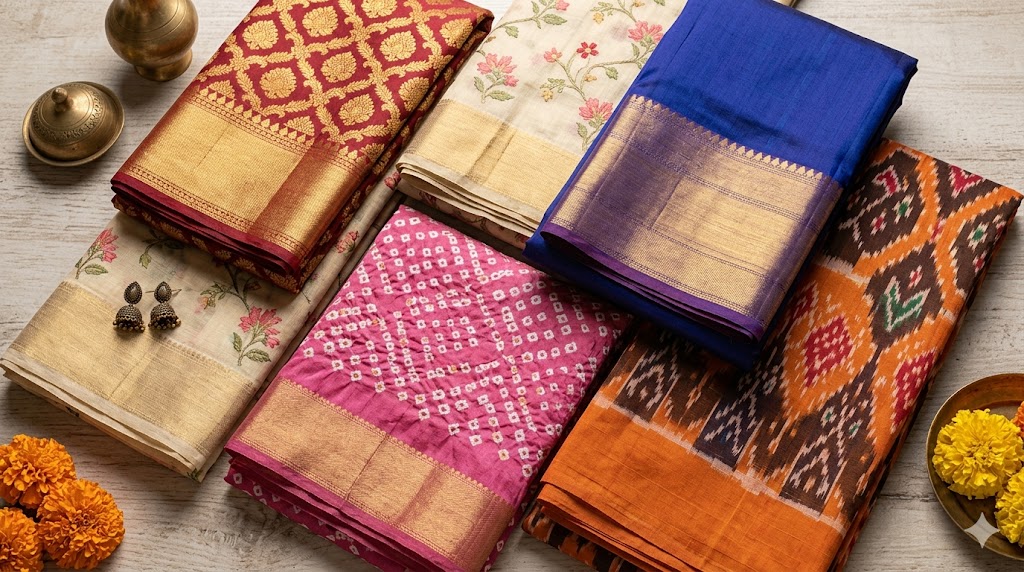
India is a land where the landscape, language, and attire change every few hundred kilometers. Perhaps no garment captures this diversity better than the Saree. Far more than just six yards of fabric, the traditional Indian sarees is a canvas of history, geography, and meticulous craftsmanship.
From the temple towns of the South to the weaving clusters of the North, here is a deep-dive into the legendary traditional sarees of India.
1. The North: Grandeur and Intricacy
Banarasi Silk (Uttar Pradesh)
Originating from the holy city of Varanasi, Banarasi sarees are the gold standard of Indian bridal wear. Known for their gold and silver zari (brocade), these sarees often feature motifs inspired by Mughal art, such as floral patterns (Butidar), bells, and upright leaves (Jhallar).
- The Feel: Heavy, opulent, and structured.
- Best For: Weddings and grand celebrations.
Chikankari (Uttar Pradesh)
While Lucknow is famous for its kurtas, Chikankari sarees are masterpieces of shadow-work embroidery. Traditionally done on light fabrics like muslin or georgette, they offer a delicate, ethereal look that is perfect for the Indian summer.
2. The South: The Gold and the Bold
Kanjeevaram (Tamil Nadu)
Often called the “Queen of Sarees,” the Kanjeevaram is woven from pure mulberry silk. What sets it apart is the “temple border” and the sheer weight of the silk. In a genuine Kanjeevaram, the border and the pallu (the decorative end) are often woven separately and then joined with such precision that the seam is invisible.
Kasavu (Kerala)
The Kasavu, or the Kerala Saree, is the epitome of elegance through simplicity. It is characterized by its cream or off-white base with a thick gold border. It reflects the pristine aesthetics of the coastal state and is the traditional attire for the festival of Onam.
3. The West: A Riot of Colors and Geometry
Paithani (Maharashtra)
A Paithani saree is identifiable by its oblique square design borders and a pallu featuring a peacock motif. These are hand-woven silk sarees where the design looks exactly the same on both sides. They are considered heirlooms, often passed down through generations in Maharashtrian households.
Patola (Gujarat)
Hailing from Patan, the Patola is a double-ikat saree. This means both the warp and the weft threads are dyed in intricate patterns before weaving. The process is so complex that a single saree can take six months to a year to complete.
- The Geometry: Look for parrots, elephants, and geometric grids.
Bandhani (Gujarat & Rajasthan)
Bandhani involves the ancient art of tie-dye. The fabric is tied into thousands of tiny knots before being dipped into vibrant dyes, resulting in beautiful dotted patterns.
4. The East: Textures and Storytelling
Baluchari (West Bengal)
These sarees are famous for their borders and pallus that depict scenes from Indian epics like the Ramayana and Mahabharata. It’s like wearing a piece of literature.
Sambalpuri & Bomkai (Odisha)
Odisha’s pride lies in its Ikat weaving. Sambalpuri sarees use a “tie-and-dye” method applied to the threads before they are woven. They often feature motifs like the shankha (shell), chakra (wheel), and phula (flower), representing the cultural roots of the region.
Muga Silk (Assam)
Produced by the silkworm Antheraea assamensis, Muga silk is unique because it is naturally golden in color and becomes more lustrous with every wash. It is one of the rarest silks in the world and is a staple for Assamese festivities.
5. Central India: The Lightweight Marvels
Chanderi (Madhya Pradesh)
Chanderi sarees are known for being lightweight and having a sheer, “woven air” quality. They are crafted by weaving silk and golden zari into traditional cotton yarn. The result is a shimmering texture that feels weightless, making it a favorite for modern women who value comfort.
Maheshwari (Madhya Pradesh)
Originally designed by Queen Ahilyabai Holkar, these sarees often feature reversible borders (so they can be worn either way) and designs inspired by the carvings on the walls of Maheshwar Fort.
How to Choose the Right One?
| Feature | Best Saree Option |
| Summertime Comfort | Chanderi, Chikankari, or Kasavu |
| Bridal Grandeur | Banarasi or Kanjeevaram |
| Artistic Storytelling | Baluchari or Patola |
| Formal Elegance | Maheshwari or Sambalpuri |
Conclusion
Every Indian saree tells a story of the hands that wove it and the land it belongs to. Whether it’s the regal gold of a Kanjeevaram or the earthy geometry of a Patola, these garments are a testament to India’s living heritage.
By choosing a traditional saree, you aren’t just wearing an outfit; you are preserving a craft that has survived for centuries.
Which of these regions’ styles resonates most with your personal fashion sense?
